Unveiling the Transformative Power of Civil Society in West Africa 

Unveiling the Transformative Power of Civil Society in West Africa 

Getting your Trinity Audio player ready...

How CSOs are Driving Development, Inspiring Change, and Shaping the Future

Across West Africa, Civil Society Organisations (CSOs) are changing lives in powerful yet often unseen ways. They work tirelessly to promote justice, improve livelihoods, empower women and youth, and strengthen democratic values. From the bustling cities of Nigeria to rural communities in Guinea-Bissau, CSOs are stepping in where others cannot, finding solutions, building trust, and lighting the way forward.

To bring visibility to this work, WACSI, with support from the Ford Foundation, undertook a major regional research effort to document the actual impact of CSOs. Moving beyond anecdotal stories, this in-depth study combined surveys, interviews, and case studies from 15 countries to showcase how CSOs are not just advocating for change; they are actively delivering it.
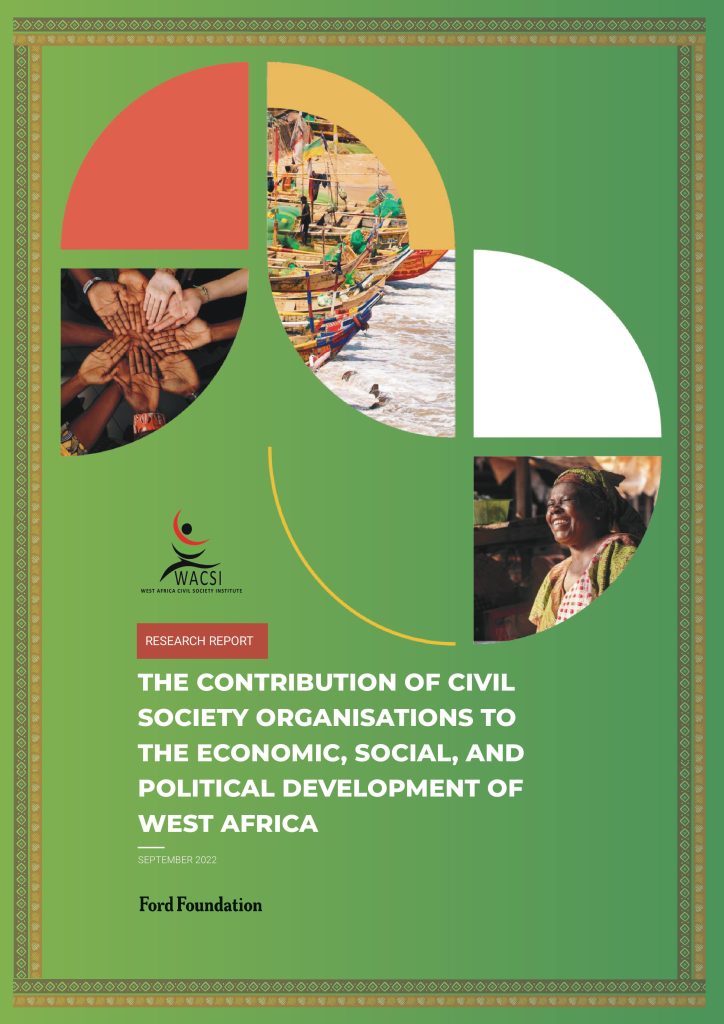
Cover page of THE CONTRIBUTION OF CSOs.. REPORT

Driving Economic Growth and Opportunity

CSOs play a critical, but often unrecognised, role in West Africa’s economic development. Their work contributes to:

  • Job Creation: Many CSOs employ full-time staff and support entire value chains — from transport providers to caterers. In Ghana, a national survey revealed that CSOs directly employed 285,000 people, a major contributor to the job market and local economies.
  • Reducing Poverty and Building Livelihoods: CSOs deliver vocational training, agricultural support, and entrepreneurship initiatives. In Nigeria, one organisation trained 500 people in alternative livelihoods, enabling many to start small businesses. In Ghana, a project provided seedlings to 300 farmers, helping them boost their income through organic farming.
  • Encouraging Entrepreneurship and Economic Innovation: CSOs incubate new ideas and help local businesses grow. They also influence economic policy, ensure fair resource distribution, and collaborate with the private sector to promote inclusive economic growth.
  • Bringing in Resources: CSOs attract substantial international funding and invest it in local projects, indirectly boosting local industries and service providers.

Advancing Social Development and Inclusion

CSOs are often the first responders to social challenges, offering services and support that governments may not provide.

  • Empowering Women and Girls: Organisations like CEDA in Liberia have supported over 7,300 rural women and young girls, helping them build leadership skills and improve their livelihoods.
  • Supporting Education and Youth Development: CSOs play a key role in improving access to quality education, providing learning materials, mentorship, and safe spaces for children and young people.
  • Improving Health, Water and Sanitation (WASH): In Ghana, a CSO built more than 5,000 latrines and installed 60 water facilities, transforming public health and hygiene in rural schools and communities.
  • Promoting Peace and Crisis Response: In times of conflict or natural disasters, CSOs provide essential support, from food and shelter to trauma counselling and conflict mediation. Their grassroots presence allows them to respond quickly and effectively.


Strengthening Democracy and Good Governance

CSOs are also playing a vital role in building stronger, more accountable governments:

  • Protecting Human Rights: CSOs advocate for marginalised communities, monitor abuses, and push for laws and policies that uphold basic rights and freedoms.
  • Promoting Political Participation and Inclusion:Through civic education and leadership training, CSOs empower citizens to vote, speak up, and engage in decision-making. In Liberia, a CSO helped rural women gain the skills and confidence to run for office — one even became a district commissioner.
  • Fostering Transparency and Accountability:CSOs monitor elections, expose corruption, and ensure that public funds are used properly. Their work builds trust in governance and encourages public participation in national development.

WACSI’s Role: Documenting, Amplifying, and Equipping

The research conducted by WACSI marks a significant step in showcasing the concrete value of civil society work in West Africa. It provides vital insights that help shape policies, inform donor strategies, and guide CSO programming.

WACSI worked closely with academic partners to ensure the research was rigorous and grounded in evidence. The findings are already being used to spark conversations, shape capacity development efforts, and build greater awareness of civil society’s contributions.

As Ms. Nana Asantewa Afadzinu, WACSI’s Executive Director, notes:
“This report is not just about numbers, it is about telling our story with power and purpose. It shows the world that civil society is a vital driver of development in West Africa.”

Turning Obstacles into Opportunities

Despite their achievements, CSOs face significant hurdles:

  • Chronic Underfunding: Many CSOs operate on shoestring budgets. Over 42% of surveyed organisations run on less than $20,000 annually, limiting their reach and sustainability.
  • Weak Support Structures: Government and private sector support is limited. Many CSOs feel isolated and disconnected from national development plans.
  • Lack of Coordination: Without better collaboration, CSOs risk duplicating efforts. Stronger networks and coalitions are needed to amplify impact.
  • Capacity and Staffing Gaps: Smaller organisations struggle to retain skilled staff. Talented personnel often leave for better-paying jobs in international agencies.
  • Concerns Around Trust and Legitimacy: Some CSOs face accusations of foreign influence or lack of transparency, making it harder to build partnerships and public trust.

Reimagining Civil Society for a Stronger Future

Over 90% of CSOs involved in the study agree that the sector must evolve. That means:

  • Becoming More Transparent and Accountable: CSOs must lead by example, setting standards for integrity, sharing results, and building public trust.
  • Developing Local Funding Models: WACSI is already supporting CSOs to improve their fundraising skills and build partnerships with the private sector.
  • Working Together: Collaboration, not competition, must guide the sector. Shared platforms, coalitions, and coordinated strategies are the way forward.
  • Tapping into Technology: CSOs must embrace responsible use of digital tools, including AI, while safeguarding human rights.
  • Telling Their Story Better: Strong storytelling helps the public, donors, and governments see the real value of civil society.

A Shared Call to Action

This report is more than a document; it is a mirror, a map, and a mandate. It reminds us that civil society is not just a participant in development; it is a driver of it. With strategic support, stronger coordination, and a bold vision for the future, CSOs in West Africa can deliver even more lasting change.

As we look ahead, WACSI calls on all stakeholders, governments, donors, private sector actors, and communities to work hand-in-hand with civil society to build a more inclusive, just, and prosperous West Africa.

Together, we can unlock the full potential of civil society and create a future where no one is left behind.


About the author

Author profile
Head, Capacity Development Unit at WACSI

Charles Kojo Vandyck is a dynamic development practitioner and thought leader who is driving transformative change within civil society. As a Founding Member of the prestigious International Consortium on Closing Civic Space (iCon), spearheaded by the renowned Centre for Strategic and International Studies (CSIS), Charles is at the forefront of transforming citizen participation worldwide. With positions as a Trustee of INTRAC and an Advisory Board Member of Disrupt Development, he is shaping the future from Oxford to Amsterdam. Charles's remarkable contributions continue as a Core Team Member of the game-changing Reimagining INGOs (RINGO) initiative and as the Head of the Capacity Development Unit at the West Africa Civil Society Institute (WACSI). Recognised by the Development Studies Association, Charles is also a certified Change the Game Academy Master Trainer and an IFC-Learning and Performance Institute Trainer. Prepare to be inspired by Charles as he paves the way for a more resilient, sustainable, and empowered civil society.

Share:

Charles Kojo Vandyck

Charles Kojo Vandyck is a dynamic development practitioner and thought leader who is driving transformative change within civil society. As a Founding Member of the prestigious International Consortium on Closing Civic Space (iCon), spearheaded by the renowned Centre for Strategic and International Studies (CSIS), Charles is at the forefront of transforming citizen participation worldwide. With positions as a Trustee of INTRAC and an Advisory Board Member of Disrupt Development, he is shaping the future from Oxford to Amsterdam. Charles's remarkable contributions continue as a Core Team Member of the game-changing Reimagining INGOs (RINGO) initiative and as the Head of the Capacity Development Unit at the West Africa Civil Society Institute (WACSI). Recognised by the Development Studies Association, Charles is also a certified Change the Game Academy Master Trainer and an IFC-Learning and Performance Institute Trainer. Prepare to be inspired by Charles as he paves the way for a more resilient, sustainable, and empowered civil society.

Leave your comments

FIIFI BOATENG

Fiifi is a Ghanaian and currently serves as Communications and Information Officer at the West Africa Civil Society Institute. He joined the Institute in December 2020.

NANCY KANKAM KUSI

Nancy is a Ghanaian and currently serves as Programme Officer in the Knowledge Management unit at the West Africa Civil Society Institute. She joined the Institute in January 2021.

AGNES ADWOA ANIMA

Agnes is a Ghanaian and currently serves as Head of the Administration unit in the West Africa Civil Society Institute (WACSI). She joined the Institute in October 2021.

DORIS ODEI

Doris holds a Bachelor of Arts in Social sciences (Economics and Sociology) from the University of Cape Coast. She is passionate about impacting young lives hence co-founded Impart Foundation. A non-profit organization which seeks to empower young lives through education, technology and entrepreneurship.

PRINCE AKOWUAH

Prince Akowuah is a Ghanaian and currently the Programme Assistant in the Translation Unit at the West Africa Civil Society Institute (WACSI). She joined the Institute in 2020.

MAXWELL APENTENG

Maxwell Apenteng is a Ghanaian and joined WACSI in September 2010. He provides gardening and janitorial services at the Institute.

GEORGE ADU-MINTAH

George Adu-Mintah is a Ghanaian and currently the Protocol Assistant/Driver at the West Africa Civil Society (WACSI). He joined the Institute in October 2006.

IBRAHIM KWAKU GBADAGO

Ibrahim Kwaku Gbadago is a Ghanaian. He joined the Institute in 2008 and provides janitorial services and assisting the institute's errands. Before joining the Institute, he worked at the Palestinian embassy in Accra, Ghana.

RUTH YAKANA

Ruth Yakana is from Cameroon and currently the Receptionist at the West Africa Civil Society Institute (WACSI). She joined the Institute in 2020.

BETHEL KWAME BOATENG

Bethel is a Ghanaian. He provides technical and IT related support to the Institute. He joined the Institute in October 2006.

WHITNAY SEGNONNA

Whitnay Segnonna holds a Bachelor’s Degree in International Management from the University of Benin. With 2 years of experience, she has a strong knowledge of organizational and project management. Combined with her bilingualism, she is very passionate about her work. She joined WACSI as Project Assistant on Critical Ecosystem Partnership Fund (CEPF) for the Capacity Development Unit.

STELLA YAWA WOWOUI

Stella Yawa Wowoui holds a Bachelor’s Degree in Translation Studies. She has a perfect grasp of both French and English, as well as an intermediate level in Spanish. She is currently working as a Project Assistant on the Techsoup Project.

KWAME ASANTE

Kwame is an experienced IT Consultant/Software Developer. He is skilled in Web Applications Development, Digital Security, Database Management, Digital Marketing and Brand Management. He holds a Bachelor's Degree in Information Technology and is a Microsoft Programme Alumni. He is currently serving as a Marketing and IT Officer on the Techsoup Project.

GRACE AKPENE ZIGGAH

Grace Akpene Ziggah is a Togolese and currently the Logistics Officer and also assists in administration duties at the West Africa Civil Society Institute (WACSI). She joined the Institute in June 2009.

LILLIAN DAFEAMEKPOR

Lilian Dafeamekpor is a Ghanaian and currently the Assistant to the Executive Director at the West Africa Civil Society Institute (WACSI). She joined the Institute in 2020.

JOHN P. FRINJUAH

John P. Frinjuah has expertise and interests in civil society, international development, democracy and governance, conflict, crisis, and security. He has extensive experience working with civil society and international development organizations where he supported and managed research, programmes, and provided technical assistance on a variety of themes around public policy, governance, and development. He is an alumnus of the University of Ghana and the Fletcher School of Law and Diplomacy - Tufts University in the United States, with a Bachelor of Arts in Political Science and Master of Arts in Law and Diplomacy from two institutions respectively. John speaks English, French and several Ghanaian and regional West Africa languages.

GERVIN CHANASE

Gervin has extensive international development experience, including 5 years of policy advocacy and capacity building of grass root organisations. He has implemented over the years a combination of agriculture value chain, livelihood, food security and governance and rights programmes.
Prior to joining WACSI, Gervin worked on two USAID projects focusing on agriculture value chain development and governance in northern Ghana
Gervin holds a master’s degree in development & Governance from the University of Duisburg-Essen, Germany as well as a Masters in Global Studies from the Universities of Vienna (Austria), Leipzig (Germany) and California (Santa Barbara), USA. He is passionate social justice and inclusion.

LEANDRE BANON

Leandre Banon, Beninese, joined WACSI in September 2014 as Capacity Development Programme Assistant. Since then, he has worked in various units within the Institute to support operational and institutional capacity strengthening programmes for civil society in the region. Currently serving as Capacity Development Programme Officer at WACSI, his main responsibilities involve designing, planning, implementing and monitoring capacity development programmes for civil society constituents and grouping across the West Africa. Leandre is a certified Change the Game Academy Programme Trainer. His background lies in the areas of economics and development planning.

SAMUEL APPIAH

Samuel Appiah is a Ghanaian and currently the Programme Officer in the Finance and Administrative Unit at the West Africa Civil Society Institute (WACSI). He joined the Institute in May, 2016.

JIMM CHICK FOMUNJONG

Jimm Chick Fomunjong, Cameroonian, joined WACSI in May 2018 as the Head of the Knowledge Management and Communication Units of the Institute. He has over ten years’ experience as a journalist and a development communications expert. He has a vast experience in supporting African organisations to strengthen their internal and external communications, building and sustaining relationships with the media and, leveraging on the power of social media to promote their mission. He is also excellent at supporting organisations to set up and operationalise functional communications and knowledge management systems. He has a deep passion and expertise in supporting Africans and African civil society organisations to document their praxis, share and learn from experiences documented from the African civil society sector.

FRANCK A. SOMBO

Franck Sombo is a development practitioner with the drive to lead self and others to influence productivity and efficiency. His work involves supporting organisations to develop strategic plans, design monitoring and evaluation systems, develop and use relevant performance measurement tools to track progress, assess organizational growth and institutionalise learning. Franck has eight years of experience working with WACSI where he currently serves as the Head, Monitoring, Evaluation and Learning. His academic qualifications include Masters in Organisations’ and Projects’ Management, and in Business Sciences and a High National Diploma in Finance and Accounting.

Franck is a Fellow of the International Program for Development Evaluation Training (IPDET) and a graduate of the Graduate Training Institute (GTI) - Ghana with specialization in Strategic Management and Corporate Leadership. He has a rich experience in Project Management, Capacity Development, Strategic planning, Data Analytics, Monitoring and Evaluation, Training and Facilitation, Mentoring and Coaching among others.

OMOLARA T. BALOGUN

Omolara is a development practitioner and advocacy strategist with over 15 years of progressive experience in development programming targeted at strengthening civil society in West Africa.

She joined WACSI in November 2009 as a Regional Advocacy Consultant and later became the first Policy Advocacy Officer of the Institute in 2010.

She was promoted to Head of the Policy Influencing and Advocacy (PIA) Unit in 2015. As the Head of the PIA unit, Omolara offers strategic direction to the Institutes’ ambitions to connect and convene groups of organised and organic civil society actors; and influence regional and global discourses on crosscutting policy issues including—civil society regulations, sustainable development goals, civic space and enabling environment, aid effectiveness, gender equality, and civil society accountability.

Previously, Omolara served as a Programmes Associate with the Women in Peace and Security Network-Africa (WIPSEN-Africa), where she worked with her team to design and implement pan-African programmes on—multidimensional peace support operations and gender mainstreaming in security sector reform in Ghana, Sierra Leone, and Liberia.

She also served as a Service Development Marshal at TVQ Consulting Group, a customer service firm focused on designing strategic customer relationship and business growth plans for private and public financial institutions in Nigeria.

Omolara is a social justice advocate, a network weaver, and a convener. She has a postgraduate degree in Peace and Conflict Studies; a degree in International Relations and History, from the University of Ibadan and Obafemi Awolowo University in Nigeria respectively.

She also holds executive certificates in Behavioral Science in Public Policy from Harvard University Executive Education in Cambridge and in Citizen Advocacy from the Coady International Institute, St Francis Xavier University in Canada.

KWABENA KRODUAH

Kwabena Kroduah is a Ghanaian and currently heads the Finance Unit at the West Africa Civil Society Institute (WACSI). He joined the Institute in January 2008.

CHARLES KOJO VANDYCK

Charles currently serves as the Head of the Capacity Development Unit at the West Africa Civil Society Institute (WACSI). Charles has over 10 years of experience working in international development and social justice issues in Africa. Charles has expertise in strengthening civil society and public agencies including the design and implementation of governance and leadership programmes, development of knowledge pieces and policy advice. Charles was the founding Board Chair of Innovation for Change (i4C)-Hub Afrique, as well as the founding member of the International Consortium on Closing Civic Space (iCon), an initiative of the Centre for Strategic and International Studies (CSIS) in Washington DC. Charles currently serves as the Member of the Governing Board (Coordination Collective) of Africans Rising. He is a Member of the Development Studies Association, United Kingdom. Charles is a 2017 Stanford University Fellow for Nonprofit Leaders and a certified Change the Game Resource Mobilisation Trainer.

NANA ASANTEWA AFADZINU

Nana Afadzinu is a Ghanaian and currently serves as the Executive Director of the West Africa Civil Society Institute (WACSI). She joined the Institute in October 2010.